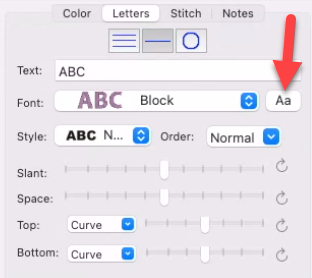
As you add fonts to your system, you’ll no doubt discover the need for a better method to search and select your fonts. The library window will help. It provides access to the fonts by search string, size, type (native or imported), designer (installed folder) and category tags that you create. You can even quickly access your favorite fonts.
To access the Fonts window, create a lettering design and look at the property page for it.
Font Property Page
Here, you will see the button, labelled “Aa”, that will reveal the Fonts window. In systems without access to the Font Library feature, the button remains the ‘?’ which is used to display the characters contained in the font. The Fonts window will now provide that functionality and more.
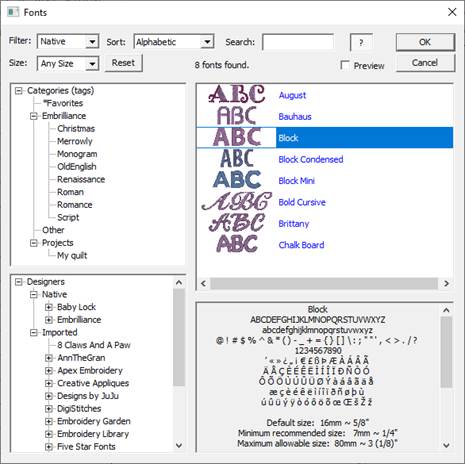
The Fonts window.
The Fonts window has five main sections:
1.) The controls at the top.
2.) The splitters between window sections, allowing you to view more or less in a section.
3.) The Categories, on the left.
4.) Fonts In Use, if any, are shown as a category.
5.) The Font List on the right.
6.) The character map of the selected font, bottom right.
7.) The Designers, below Categories.
Most of the controls are self-explanatory, but let’s take a closer look:
“Filter” selects font types you may be interested in, specifically native (digitized and published within Embrilliance), Imported (stitch files grouped and imported into a font by AlphaTricks) or All.
“Size” selects fonts based on height. For native fonts, the size ranges include any font within a range, and for stitch-based (imported) fonts, the default size is used, as that contains no stitch processing or distortion. Size is a selection from Micro to XL and the ranges do overlap: You may see a font in more than one size category. The exact numbers used to select the ranges are not important, as they are guides to get you into range. If it seems the fonts shown are too small or large, simply select the next size range up or down. Use the character map to see size specfics for any selected font.
“Sort” organizes the font list by name or size, in a few versions. The list will be shown in ascending order, but if you want to invert that order, select the same Sort option again, and it will reverse.
“Search” allows you to find fonts by name, or any part of the name. It also filters the results of any other criteria, such as Native with “Merr” might yield the fonts in the Embrilliance PatchArtist collection.
“Reset” clears the search fields and displays all fonts in the list.
“?” is a duplicate of the same button used in the Platform lettering properties window. It shows/hides the character map. You may want to hide it if you’re looking through a large collection of fonts.
“Preview” is a checkbox that, when checked, will send a message to the main Platform window. The currently selected design will have its font temporarily set to what you select in the Font List. This lets you view any design with any font, just to see how they will appear. Note that not every font will be available at every size, so the size of the selected lettering may change accordingly as you preview various fonts.
“OK” is used to select the current font for the lettering design. This is the same as if you chose the font from the normal pop-up control on the lettering property page. This will also save the window state and position for your next use.
“Cancel” will undo any preview and return you to the Platform and property page as you were.
Above the Font List is a note telling you how many founds were found under the current search conditions, or if none are chosen, it will list the count of all fonts.

Splitters
The size and position of the window can be changed by dragging with the mouse, as any normal window in your OS. The splitters are areas between views in the window that allow you to drag more or less visibility.
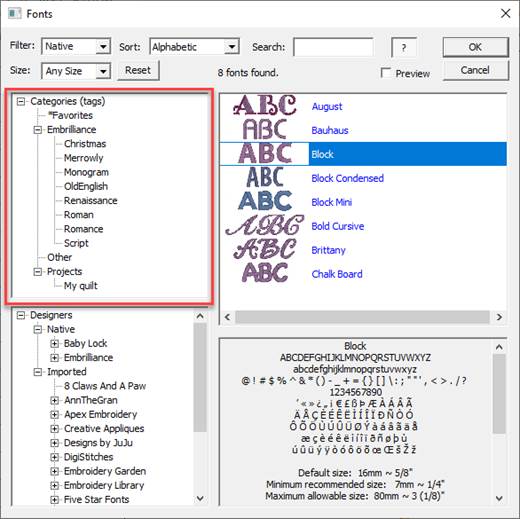
Category View
The Categories view contians a tree, or heirarchial list, of words that are used to find fonts easily. These categories are merely words, similar to tags you may be familiar with on the internet. The categories are defined by you. We’ve started the first for you, and called it, “Favorites.” It has an asterisk next to it, which should keep it at the top of the list, which is alphabetically sorted.
Right-click on a category to add a sub-category under it. Right-click the top word, “Categories (tags)” to make a new root-category instead of a sub-category. There is not real limit to the number of nested levels your categories can be made, however, for practicality we suggest no more than three or four.
To delete a category, right-click on it and that option will appear.
To rename a category, click on the label text. You may have to wait a second and click again, and the OS will let you edit the label. Once you are finished changing the text, hit Enter on your keyboard.
Categories cannot be moved around. If you find you made a mistake, you can make a new category in the correct place, select the old category which shows the font list for it, then categorize those into the new one. Once they are there, you can delete the old category.
Categorize fonts by selecting fonts in the Font List, one or more, and then drag those selected fonts to a category. You can then see that they were tagged in that category by selecting the category. You’ll also see the font count change; in case you’re looking at a lot of fonts.
If you want to edit the categories that a font or fonts belong to, select them in the Font List and right-click. You’ll see the option to do so.
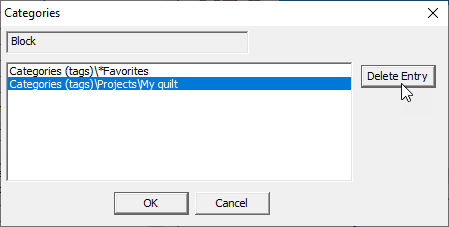
Edit Category Entries
In this window, select the lines, one at a time and click Delete Entry. When done, close the window. There is no Undo, so if you make a mistake, simply re-categorize the font(s).

Fonts In Use
When you have more than one lettering design in use, it can be helpful to know what fonts are currently selected, even across multiple design pages (or tabs) in the Platform. This category lets you select from the fonts in use, which can be handy if you want to replicate a look from one design to another by using the same font.
If you only have the one design, or one font, this category will not appear.
In your library folder, under fonts, is a file called, “FontTags.BL”. This file is used to store the categories you have created, as well as other information including display names for fonts. It is a text-based file, meaning you can edit it manually if you know what you’re doing. We suggest you don’t. This file can move with your fonts from one computer to another, even across operating systems, so that your work cataloging fonts can be used on all your Platform installations.
The Font List has some options. You can select one or more fonts. If only one is selected and Preview is chosen, that one will be used in the Platform main view.
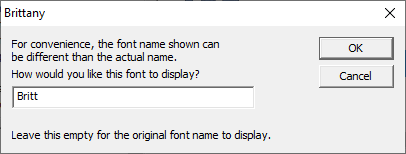
Display Name Window
Individual fonts have names provided by the digitizer that created them. You may want to rename a font. Fonts won’t have their real names actually changed, but you can add a display name. This helps you identify them easier. Note that searches will look at both the real name and display name. Also, the character view will show both names. If you want to remove your display name, simply empty the text box in this window and click OK.
Discard Font is a right-click option in the Font List. When you run across a font you no longer need or want, you can discard it. This removes it from your font list, and the font will not load any longer. Fonts that are discarded are moved, along with their full folder path, into a library folder called Discarded. This folder is not emptied, unless by you. At any time, you can open the Library Folder from the Platform, find the font folder, and move it back into position. If you really want it permanently deleted, that’s your call.
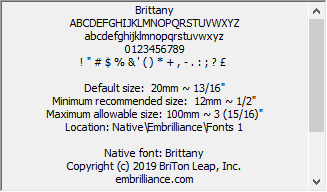
The Character Map
When a single font is selected, and the Character view is enabled, the contents of the font and license, location and size are displayed in a scrollable window. You can use this information to ensure the font has any special punctuation desired, or check size availability, etc.
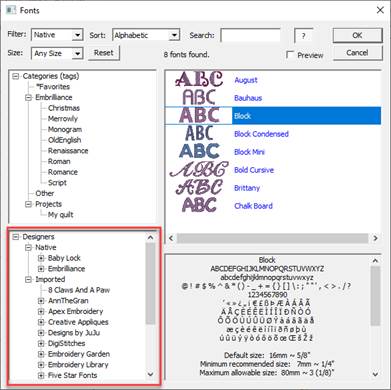
Designers Tree View
This view is used to display the folder structure of your Fonts folder in your library. You don’t edit this. It is simply showing the layout of the fonts you have installed, either from Embriliance products or BX installations. The usefulness of this window comes from being able to select a specifc designer or product and see only those fonts.