 There are a number
of preferences for the program and design page that can be adjusted. Click on
the Preferences button to reveal these controls.
There are a number
of preferences for the program and design page that can be adjusted. Click on
the Preferences button to reveal these controls. There are a number
of preferences for the program and design page that can be adjusted. Click on
the Preferences button to reveal these controls.
In the Preference window, under Environment, you can choose a hoop. Hoops are displayed in a sorted list, organized by embroidery file format. Most embroidery hoops are made using the metric system, so the sizes for the hoops are displayed according to the way the manufacturer sells the hoop. An approximate size in inches is also shown.
There are many hoops that are built into the program, and you can add your own. As the program updates over time, or if you have edited a hoop, use the “Defaults” button to restore the program to the hoops provided. The “Default” button will not, however, remove any hoops you’ve added yourself.
Optional by product: Depending on which products are licensed, some multi-position hoops may be listed – they have “Multi” listed after the size. Designs will automatically split upon the Save and a text file will be created with the stitching instructions. See the section on “Multi-position Hoops” for more information.
Many times, you will want to sew a design sideways in the hoop. But rather than laying out your design sideways, it might be convenient to have the hoop displayed as rotated. Checking the “Rotate 90” button accomplishes this. Double-click the hoop indicator on the status bar to rotate the hoop 90°.
You can create hoops and edit hoops too. If you use the word, “Round” or “Oval” in the name, your hoop will be drawn using that shape. When you create a new hoop, it will become
the selected hoop. If you have added a hoop, or if you decide to have the program display only the hoops that you own, you can delete hoops from the list, using the “Delete” button.
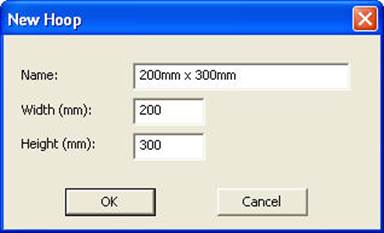
The width and height fields are self-explanatory, and you can name your hoop as desired. Hoop names should be unique.
Note: Do not create a hoop that is bigger than the sewing field of your embroidery machine.
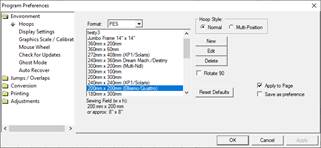
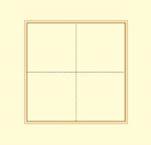
Left: Hoop selection. Right: What a hoop looks like in the Main View.
When you create a new hoop or modify an existing hoop, you are really defining the embroidery field, not the physical dimensions of the hoop. You must know your machine’s embroidery field as you cannot use a hoop that is larger than what your embroidery machine can sew, unless you are creating a multi-position hoop, which we’ll discuss separately in the Multi-Position Hooping section.
Check the status bar at the bottom of the window for hoop information, which displays the selected hoop size whether it is visible or not. Zoom out to find the hoop (if it isn’t hidden by your design).
Note: If your program is licensed to use it, there is one hoop, the .PES Jumbo 14” hoop, is shown in both the Normal and Multi-Position section of the Hoop Preference. Using either selection will create the correct file for use with this hoop, however, the Normal version displays it as a single sewing field, and the Multi-Position version shows both fields in use.
The Main View is calibrated to a real-world scale for precise display of designs. Use the Preferences Window to calibrate your display for real-world size:
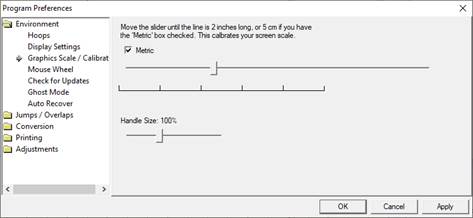
Hold a ruler up to your screen and adjust the slider until the measurement in the program matches your real-world ruler. This will help you better estimate real design size while editing designs.
The DPI set by this calibration is also used to other graphics within the program to display at a useable size. High-DPI systems like 4K laptops can make images appear very small without this.
On this property page there is an additional scale called ‘Handle Size’. The handles are the graphics you place the mouse over on the main view so you can drag: Sizing, rotating, outline nodes, etc. It will also adjust the size of the rulers at the top and left of the screen. The handles will scale with the main calibration, but this slider allows you to increase/decrease the size of those handles. This can be useful to accommodate small displays, accessibility issues, hi-res monitors, etc.
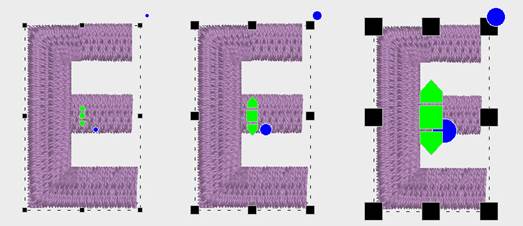
Handle sizes can be varied depending on preference, monitor, etc.
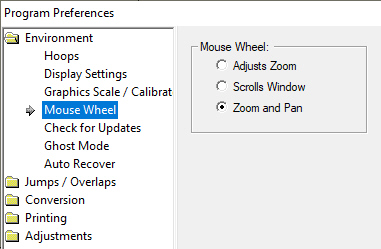
The Mouse Wheel can be used to zoom the Main View. It can also be used to scroll the page up and down. We recommend that you use the setting that allows for zooming as this is more useful to most users. The Zoom and Pan feature will center the view at the point of the cursor while zooming.
Auto recover will save your file in a separate space every so often. This is adjusted using the slider. This feature is useful when working on a complex arrangement where a power outage or program crash (unlikely) or freeze by the operating system (it happens) could force the program to quit and you might lose your work. If you are working while power-outs are happening, well, turn this on. Please don’t run your embroidery machine when the power is unreliable, as brown-outs are not good for them.
The program can check for updates if it is running on a system connected to the internet. This will occur once each day, the first time that you run the program. The program does not send your information or anything about you or your computer to us. It merely checks the current version available online for your program and if there’s an update, it lets you know. If you don’t want this, you can turn this off.
You can also check for updates at any time from the option in the Help menu.
Most embroiderers have one machine or other that they use most for embroidery and that machine has a format that it uses. To save time, the format that you choose here will automatically be selected during the save.
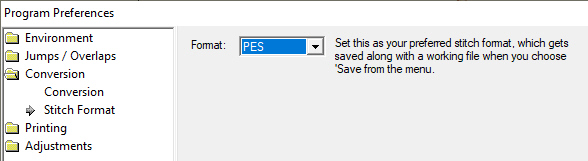
Note: Even though you have set a preferred format, you can still choose File > Save Stitch File As if you need to occasionally save in a different format. After selecting a new format in the ‘Save As’ dialog box that format will “stick,” overriding the Preferred Stitch Format until you either reselect the preferred one or select a new one.
Note about SHV: Setting the preferred format to SHV does not create the file structure your machine may expect to see. To create a proper Designer 1 diskette or stick, please read the section on Creating A Designer 1 Disk or USB Stick.
Designs can be saved into many different formats. The Conversion Preference allows you to adjust some parameters when you save in those different formats.
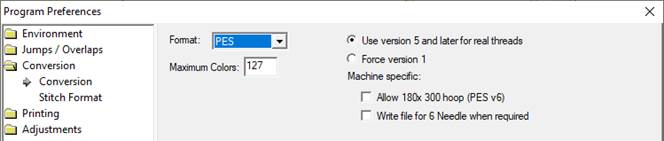
The file format itself may have inherent limitations on the number of colors or stitches, such as the 16-color limit in .PCS. But there are also machine limitations too. Older machines that use the .PES format had limits of 100 colors, whereas the newer ones can go to 127. To help you save files correctly for your machine, there are options for some formats, such as .PES.
PES Files have to support two distinct machine types, and also have different data for the support of card reader/writers that many .PES machines required. Let’s look at the .PES options more closely.
“Use version 5 and later for real threads.” This setting exists because the version 5 of the Palette/PE-Design software, which invented the .PES file, added support for real thread colors. This was a wonderful addition for this format. However, if you own an earlier version of the software, and you want to use files created in Embrilliance, then you need to leave this set to “Force version 1.” The reason is simple: The old software simply cannot open those version 5 files.
The machine specific settings are for machines like the Ellegante, which takes the 180 x 300 hoop (while other machines may not be able to accept this hoop, so why write a file for it.) Or the multi-needle machines that have their embroidery field rotated to a landscape position. So, a 200x300 or a 300x200 field, while technically the same size, have different rotational parameters.
Certainly, you know if you have a multi-needle machine, or require the use of older software to write your card. If not, or if you are distributing these designs, please just leave the settings as-is. The program actually finds a Lowest Common Denominator in the format that it will output, making the file available to the widest range of users.
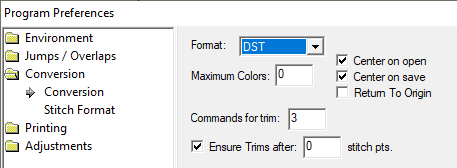
DST Options are different
DST and EXP Files have a different type of information contained in them where it pertains to jump stitches. Rather, those formats have to have some number of “Jump” commands in a row before they will cycle their thread trimmer. When making a DST file, and converting from something else, these jump commands need to be translated. As machines differ in setup for the number of commands needed to cycle the trimmers, we offer this setting in the conversion preferences.
DST files also have the ability to place themselves anywhere in the hoop. By default, the program will center designs when opening and saving, however users of commercial machines may require this to be turned off. Use the checkboxes ‘Center on open’ and ‘Center on save’ for this purpose.
Some commercial embroidery machines do not automatically return the needle to the start of the design. The option Return to Origin will add these commands to the end of a DST file.
There are several operations that occur during the process of saving a stitch file.
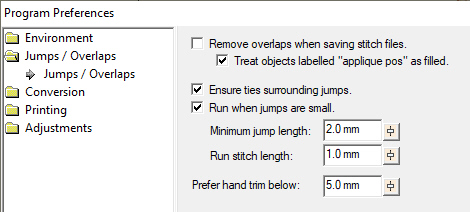
The ‘Remove overlaps…’ setting, better known as ‘Remove Hidden Stitches’ or ‘RHS’ will let the program run a process to remove stitches in one design that will be hidden by another design. This does not affect objects within a design, as those would naturally be hidden or not, as digitized.
Removing overlaps allow you to merge designs onto the page with them touching or overlapping each other. This operation is common in graphics, but stitches are not graphics. Adding one design on top of another will cause excess density and can break needles, ruin projects and all the accompanying misery that comes with it. By removing those hidden stitches, using our patented method, you will find that your composition sews without the density headaches.
Overlapped appliques are even harder for software to handle. Where layering in stitches is a concern, layering of applique fabric has extra considerations. The program has color settings where the user can tell it that a certain color is a specific applique step. With this information, the program can avoid performing RHS on appliques, as necessary.
Jump stitches are created when, within a single color, the needle must travel across the design without sewing stitches. Jumps are normally trimmed by hand or machine. Sometimes there are merged designs which have jumps that the digitizer assumes will not be cut, such is the case with many commercial designs. When the digitizer decides not to cut the jump, they don’t usually leave a tie-off stitch, which prevents the thread from unravelling after the jump gets cut.
Ensuring that there are tie-offs on either side of a jump will allow you to cut those jumps even if the person digitizing the design hadn’t planned for it.
Jumps have other parameters, usually concerning commercial embroidery. For instance, an embroiderer may prefer to hand trim, or have the option to hand trim, small jumps. In commercial embroidery, these are often left untrimmed.
Sometimes jumps are short enough that the machine can place a stitch or two instead of jumping. This process, called, “nesting a stitch,” saves the machine operator time by not having to cut and not having the machine cut, which takes many seconds, cutting production efficiency. The setting, “Run when jumps are small” allows you to set the size of a jump that may be nested with stitches and the ‘Run stitch length’ controls how many nested stitches will be created. A short run stitch, such as 1.0mm, or even smaller, will nest well in most fabrics, but you don’t want a long run of small stitches, which is why the ‘Minimum Jump Length’ parameter is there.